


FALL 2025
Rescued or Recaptured? Understanding the Political Manipulation of Cynthia Ann
Parker’s Story
Andrea Castro
Lone Star College

Andrea Castro is a first-year student at Lone Star College, currently working toward an Associate of Arts degree in English. When she was younger, she discovered her passion for reading, writing, and debating. After realizing her aspiration was to become a lawyer, it has turned into her goal, knowing it will also allow her to give back to her community. Her interest in learning more about the history of the United States ultimately led her to conduct research on women's perspectives through the lens of micro-history. She presented her research at the Great Plains Honors Conference in March of 2025. After completing her undergraduate studies, Ms. Castro intends to continue to pursue her ambitions and education.

ABSTRACT
While previous studies tend to mention Cynthia Ann Parker merely as a footnote in the biography of her son, Quanah Parker, this research aims to highlight her historical significance by focusing on her second capture, exploring Parker’s often-overlooked experience as opposed to those of her more commonly studied male contemporaries. This research first examines the work of Paul H. Carlson and Tom Crum, and what their historiography has established about the manipulation of Cynthia Ann Parker’s story, arguing it was exploited to propel Captain Sullivan Ross’ political career. Then, a primary source analysis of various reports written by Ross about the “battle” at Pease River, where Parker was captured, indicates major inconsistencies in the incident’s narrative. The difference in numbers of Comanche casualties, as well as exchanging the name of the tribe’s chief, both suggest that Ross utilized the return of Cynthia Ann Parker to camouflage a dishonorable event, despite her struggles with readjusting to her former life. As exposed through a methodological reinterpretation of women’s history, Ross’ manipulation of the narrative further emphasizes the omission of Parker’s perspective in addition to a lack of direct access to her voice. Lastly, after conducting a comparison to a similar event, such as the rescue of Lizzie Ross at the Battle of Wichita Mountains, findings cast doubt over the reasons behind the popularity of Parker’s story as opposed to Ross’. This research proposes that Captain Sullivan Ross took advantage of Cynthia Ann Parker’s return by morphing a massacre into the story of a heroic rescue, diverting historians’ focus away from her character and personal challenges.
RESCUED OR RECAPTURED? UNDERSTANDING THE POLITICAL MANIPULATION OF CYNTHIA ANN PARKER
Cynthia Ann Parker, captured not only once, but twice in the span of almost three decades, has been examined by historians as a participant in other accounts. For instance, she is often mentioned as Quanah Parker’s mother, who is considered to be the principal chief of all Comanche. The 19th governor of Texas, Sullivan Ross, was popularly involved in the event in which Parker was “rescued”. In the same way, the stories of her capture and assimilation into Comanche culture tend to be utilized while studying Texas conflicts between settlers and Native Americans. The character of Cynthia Ann Parker has seemingly created a pattern throughout the years, in which her narrative is described through the lens of the male participants in her life. While studies tend to mention Parker simply as a footnote, most historians have yet to recognize or acknowledge the harsh reality behind what they labeled a “story.”
This research seeks to emphasize the manner in which, through manipulation of essential information, the account of Cynthia Ann Parker was overemphasized in order to potentially overshadow the unpleasant outcomes of the Battle at Pease River. In both a direct and indirect manner, the popularity of Parker had been taken advantage of at the expense of not only her name, but the struggle of reintegrating into white society, which she was unwillingly subjected to. Through the analysis of Sullivan Ross’ reports, the contrast between them and other militiamen’s, continuous inconsistencies in the accounts, and the comparison of Parker’s second capture to that of Lizzie Ross’, this research seeks to unveil the potential hidden motives behind the strategic sensationalizing of Cynthia Ann Parker’s narrative.
Given the significant difference in numbers between Texas Rangers and the Comanches at the Pease River, and the one-sided outcome of loss as the Rangers remained unharmed, findings suggest that Captain Ross diverted the attention from a violent truth by focusing on the news of having found Parker. Such actions would manage to take the spotlight, not only from an unjust incident, but from the misfortunes that continued to fall upon Cynthia Ann Parker afterwards.
1 Lawrence Sullivan “Sul” Ross (1838-1898), born and raised in Texas, was a Ranger and general during the Civil War. He was elected governor of Texas in 1886 and became President of the Texas A&M University in 1891.
1
A CAPTIVE'S CAPTIVATING STORY: BACKGROUND AND METHODOLOGY
To fully understand the arguments presented in this research, it is essential to trace the conflict to its roots. On May 19, 1836, Cynthia Ann Parker was captured during the Comanche raid at Fort Parker, Texas. Nine-year-old Parker was able to fully assimilate into the tribe’s culture after being adopted by a Comanche family, forgetting the English language, and eventually marrying Peta Nocona. Parker gave birth to three children; between Quanah, Peanuts, and Prairie Flower, Quanah Parker would become an important character as the principal and last chief of all Comanche. In 1860, while Cynthia Ann Parker, among other women and children, stayed in a Comanche camp near the Pease River in Mule Creek, Texas, she was discovered when Rangers led by Lawrence Sullivan Ross attacked them. Twenty-four years after her first capture, Parker had been taken once more from her family against her will, as the rangers led her back to white society, where she struggled to readjust, and passed in 1870.
The study of women’s history consists of analyzing the commonly spread narratives with a critical lens, specifically searching for women’s contributions in order to further understand the events. This research exposes, through a gendered focus, Cynthia Ann Parker’s impact on public perceptions regarding Captain Ross and the incident by Pease River. Whether purposefully exaggerated or largely overlooked, studying the captures of Parker and Lizzie Ross can be essential for deepening the understanding of how women’s narratives are often manipulated or omitted for the benefit of others. In consequence of the distortion of facts and the scarcity of direct sources, the study of these historical events proves to be challenging; because she no longer recognized the English language as hers, Cynthia Ann Parker’s means of communication were significantly reduced. Despite not having access to her voice, this research aims to piece the narrative together by comparing accounts of the Pease River incident, thus illustrating how it is possible to reintroduce women’s perspectives into history through limited sources.
SEARCHING BEYOND THE FOOTNOTE: HISTORIOGRAPHY
Cynthia Ann Parker’s life has been discussed by multiple historians, as they try to make sense of how her life looked like after being captured by the Comanches, and then “rescued” by white soldiers 29 years later. Most approaches are centered around the conditions and events surrounding her at the time; books and articles tend to fixate on commonly executed raids between settlers and Comanche tribes, and the way in which Cynthia Ann Parker was discovered among them. This paper will further analyze the reports written by Captain and Texas Ranger Sullivan Ross, after the attack at Pease River, Texas, for a deeper understanding of how Cynthia Ann Parker’s case was taken advantage of and whom it benefited. Either by choice or ignorance, most historians have made use of eyewitnesses’ reports that do not corroborate with one another.
It is Paul H. Carlson and Tom Crum —authors of the book Myth, Memory, and Massacre—who defy the narrative, by questioning the overall reliability of constantly used primary sources, which “contain conflicting information, fabrications, and errors of major significance.” Whether by participants who were present back in the 19th century, or current historians studying the incident, Carlson and Crum affirm that history had been transformed by distortion. The reports made by Captain Sul Ross about the Battle of Pease River, for instance, are deemed problematic because of the constant modifications and inconsistencies. He claimed to be the first to recognize Parker, but so had “at least five different men,” and in an 1870s statement, flaunted about killing Cynthia Ann’s sons and husband, the chief. To understand the reasons behind misleading sources, the authors raise question of what the people involved in Cynthia Ann Parker’s recovery possibly gained from “manipulating” the narrative. In their article “The ‘Battle’ at Pease River and the Question of Reliable Sources in the Recapture of Cynthia Ann Parker,” Carlson and Crum start by analyzing Sul Ross’ character, as the person who led federal troops into the Battle of Pease River, and “recaptured” Parker. The authors claim it had been this experience, where Ross “gained more from the ‘battle’ than anyone else,” that would eventually fuel his election to become the Governor of Texas, by enhancing the public’s opinion on both the events and his own character.
Despite concentrating on the nature of the incident and whether it should be called a massacre instead, Carlson and Crum affirm that without Cynthia Ann Parker’s return, “the Pease River incident would have remained another little-noted, though deadly, encounter.” Following their argument, Sul Ross would continue to take advantage of the event through the next 30 years by giving himself a more predominant role in what was already a captivating narrative, as “not an uncommon occurrence in nineteenth-century Texas.” Because rescuing Parker brought Captain Ross and his companions into the spotlight, Carlson and Crum argue, it seemed natural for them to capitalize on the story. This argument will be explored and further developed throughout this research.
After hearing news of a girl previously lost to the Comanches coming back, people “took intense interest in Cynthia.” S. C. Gwynne makes mention of women being in charge of cleaning and dressing Cynthia Ann, and with an interesting choice of words, describes the action as “comic relief amid the tragedy.” After getting the chance to escape into her tent and retrieve Comanche clothing, the women stopped trying to “pretty her up.” According to many, this would not be the last time Parker would have had to forcefully step outside of comfort in regards to clothing. According to Lawrence T. Jones, “Mrs. John Henry Brown and Mrs. N. C. Raymond of Austin took a special interest in Cynthia Ann and dressed her in new clothes,” then led her to a photographic gallery in February of 1861.
Presumably taken at the same time as Cynthia Ann’s, Jones describes the photograph of a Comanche boy called Pease Ross, who was kidnapped and given a name by Captain Sul Ross. Despite his abduction and incorporation into white society, Pease Ross did not have as much coverage by the time’s media as Cynthia Ann Parker, whose life had become a story of success with a dramatic but “happy” ending. Gwynne claims the boy had also been involved in the battle where Parker was taken, and after being Ross’ horse tender, Pease “married a former slave, became a respectable citizen of Waco, and died in 1883.” Other than this, not much information seemed to be relevant, for the Comanche boy barely receives mention in the Pease River narrative.
Despite the initial popularity of Cynthia Ann Parker’s narrative, historians have not put enough emphasis on how her life was seemingly overshadowed by Captain Sul Ross, who positioned himself as the one responsible for a “family reunion”. Through their articles, authors like Paul H. Carlson and Tom Crum have begun an inquiry into the essence of Cynthia Ann Parker’s recapture; their approach, however, is regularly centered on the potential motives behind Ross’ actions. This paper will further analyze the events of Cynthia Ann Parker’s life after the Battle of Pease River, eyewitnesses’ recounts, as well as Captain Sul Ross’ reports, in order to clarify how her narrative was controlled by others due to a lack of Parker’s testimony.
2 Paul H. Carlson, and Tom Crum. “The ‘Battle’ at Pease River and the Question of Reliable Sources in the Recapture of Cynthia Ann Parker.” The Southwestern Historical Quarterly 113, no. 1 (2009): 32–52. http://www.jstor.org/stable/27794584.
3 Ibid.
4 Ibid.
5 Ibid.
6 Paul H. Carlson, and Tom Crum. “The ‘Battle’ at Pease River and the Question of Reliable Sources in the Recapture of Cynthia Ann Parker.” The Southwestern Historical Quarterly 113, no. 1 (2009): 32–52. http://www.jstor.org/stable/27794584.
7 Jones, Lawrence T. “Cynthia Ann Parker and Pease Ross: The Forgotten Photographs.” The Southwestern Historical Quarterly 93, no. 3 (1990): 379–84. http://www.jstor.org/stable/30241332.
8 S. C. Gwynne. “Empire of the Summer Moon: Quanah Parker and the Rise and Fall of the Comanches, the Most Powerful Indian Tribe in American History”. 2010.
9 Ibid.
10 Jones, Lawrence T. “Cynthia Ann Parker and Pease Ross: The Forgotten Photographs.” The Southwestern Historical Quarterly 93, no. 3 (1990): 379–84. http://www.jstor.org/stable/30241332.
11 S. C. Gwynne. “Empire of the Summer Moon: [Quanah Parker and the Rise and Fall of the Comanches, the Most Powerful Indian Tribe in American History]”. 2010.
2
3
4
5
6
7
8
9
10
11
IN ATTEMPTS OF REWRITING THE PAST: PRIMARY SOURCE ANALYSIS
RECLAIMING PARKER'S NAME: CONCLUSION
While historians have widely engaged in discourse that includes Cynthia Ann Parker, either as a primary or secondary figure, there is little emphasis made on how her “rescue” benefited Parker’s male contemporaries. In order to expose risks along the state’s territory caused by conflicts between Comanche tribes and white settlers, and to portray the Battle of Pease River as a major victory for Texas Rangers, the narrative of Cynthia Ann Parker has been employed to discuss different aspects of history in 19 th -century Texas. The story is also used to expand upon her son, Quanah Parker’s memoir, as well as that of former Governor of Texas, Lawrence Sullivan Ross. A previously mentioned example of a minimized portrayal is Gwynne’s book, The Empire of the Summer Moon, which mostly focuses on Cynthia Ann’s son, Quanah. Cynthia Ann Parker’s narrative is briefly mentioned throughout the book, and while her life events are acknowledged, Gwynne primarily concentrates on her son after a couple pages. Most historians have employed her narrative to justify or prove a point; still, they were not the first to do so. After 1860, books and articles written as a result of Cynthia Ann’s recapture rely on the event to enhance the public’s response, creating a pattern that is often overlooked. The purpose of this research is to highlight the manner in which the account of Cynthia Ann Parker’s second capture was exploited. Because of the similarity in arguments, this paper will draw upon Paul Carlson and Tom Crum’s work, Myth, Memory, and Massacre, published in 2010.
In their book, Crum and Carlson claim that in many of the stories recorded about the Pease River incident, men “attempted to place [themselves] and [their] friends in as significant positions as possible,” which sometimes “meant constructing a bit of information about incidents that did not occur.” The authors are referring to the accounts of Texas Rangers and citizen militiamen who, along with Captain Sullivan Ross, wrote differing descriptions of what they call “the truth”. Said inconsistencies recorded by Captain “Sul” Ross are essential to illustrate his motives, and allegedly positive outcomes, of the incident. Jonathan Hamilton Baker, who was a militiaman, kept a diary of his experiences throughout the expedition. Through his entries, Baker expressed doubts regarding the reliability of Sul Ross’ accounts.
Despite being absent during the battle at Mule Creek, when Baker was informed of the situation by Ross, he was told that troops had “overtaken a party of 15 Indians and had killed 12 of them and taken three prisoners.” However, after a brief inspection of the site, Baker was only able to find seven of the dead Comanche members; four of them were women, three were men. Later that day, he wrote, “Some of the men who came in late say that they trailed six or eight Indians who made their escape during the fight yesterday. So Capt. Ross was mistaken about killing all the Indians.” While Baker decided to believe it had been an honest mistake, it is almost impossible to know the captain’s real intentions.
Even if Ross had truly confused the details of the fight, it would not be the first, nor would it be the last time. Over the course of two decades, Captain Sul Ross continued narrating and rewriting his side of the story, with certain variations that seemed to go unnoticed. In the book Indian Depredations in Texas, published by historian John Wesley Wilbarger in 1889, he transcribes sections of Ross’ reports where he states:
The chief of the party, Peta Nocona, a noted warrior of great repute, with a young girl
about fifteen years of age mounted on his horse behind him, and Cynthia Ann Parker,
with a girl child about two years of age in her arms, and mounted on a fleet pony, fled
together, while Lieutenant Tom Kelliheir and I pursued them.
In this account, originally written in the mid-1880s to James T. DeShields, an author and friend of the captain, Ross confidently names the people involved. Not only did he call the chief “Peta Nocona,” but then proceeded to elevate the character, describing him as a “noted warrior of great repute.” Authors like DeShields made sure to distinguish the chief with similar adjectives, all the while embellishing the nature of the conflict at Pease River; Wilbarger, for instance, stated that the battle was fought “between a superior force of Comanches under the implacable chief, Peta Nocona on the one side, and sixty rangers led by their youthful commander, Captain L. S. Ross on the other,” thus magnifying the impact of the narrative through the identity of the chief.
Unfortunately, according to a letter written by the captain and published in the Galveston News in 1875 —which he claimed contained the “correct history”— Nocona’s story is a lie. In the letter, he notes, “…I had the chase to myself for two miles, when I came up with Mohee, the Comanche chief of that party of Indians, and after a short fight I killed him.” The reason behind Sul Ross’ exchange of Chief Mohee for the “great” Peta Nocona are unknown; they are not, however, difficult to infer. By the 1880s, Peta Nocona had gained great popularity in Texas, due to his association with Cynthia Ann Parker as her husband, and his role as Quanah Parker’s father. It is essential to consider Ross’ growing interest in pursuing political positions, specifically running as a candidate for the Texas Senate in October 1880, and five years later, for governor of Texas. In a letter following Sul Ross’ first report, Sam Houston praised him and affirmed that, if he continued to excel at protecting the frontier, “the people will not withhold their praise.” By deliberately morphing a lesser-known chief into a renowned warrior —husband of the already-popular Cynthia Ann Parker—Sul Ross would manage to earn both praise and the position of governor in 1886.
The misleading alterations cast doubt on the reliability of Ross’ account, like those presented in the case of the number of Comanches. As previously mentioned, Captain Ross had initially reported 12 Indian casualties, which the narrative sent to DeShields in the 1880s replaces with complete omission, potentially for political motives. In a detailed description of the events, the captain makes no mention of the number of deaths, nor does he acknowledge that most of the victims were women who did not retaliate. It is possible that a story about twenty Texas Rangers killing seven members of the Comanche tribe, from which the majority were women trying to escape, would not be as appealing as the rescue of previously lost Cynthia Ann Parker.
By neglecting the unfavorable odds faced by the Comanche party, Ross avoided exposing the events at Pease River as anything less than a victorious battle, and the return of Cynthia Ann Parker helped to ensure a positive reaction. Wilbarger stated, for example, that “…it would be impossible to do anything like justice to the romantic, adventurous, and altogether splendid and brilliant career of the brave and daring young ranger who rescued Cynthia Ann Parker from captivity.” His statement glorifies, without irony, Captain Sul Ross’ character, portraying him as the heroic figure responsible for returning a captured white woman to her family.
While Parker’s story is captivating, it is not unique; another girl was also taken by a Comanche tribe and later retrieved by Sul Ross. According to Wilbarger, in 1858—just two years before Cynthia Ann Parker’s return—Ross noticed a “little pale face, apparently about eight years of age” among a group of Comanche fugitives. The group consisted of women and children attempting to escape from a confrontation with the rangers; as the girl ran past his squad, the captain ordered them to seize her. Due to the lack of information about her origins, she was “adopted by her brave and generous captor” who gave her the name Lizzie Ross. Her capture reflects similarities to that of Cynthia Ann Parker; both were taken by Comanche tribes and later returned to white society by the same captain after a battle.
Despite these parallels, it was only Parker’s narrative that bolstered Sul Ross’s reputation as a celebrated figure, raising the question of what separated the two accounts. The conflict that Lizzie Ross attempted to escape turned out to be the Battle of the Wichita Mountains, about which Wilbarger writes: “The loss of the whites was five and several wounded. The loss of the Comanches was eighty or ninety warriors killed, many wounded, and several captured; besides losing all their horses, camp equipage, supplies, etc.” From the significantly larger number of Comanche casualties, the Battle of Wichita Mountains would represent a greater victory for Texas Rangers, and the recovery of a captured girl further symbolized a cause of celebration. It is the “loss of the whites,” however, that makes the difference between a “battle” and a “massacre”, as authors Crum and Carlson have described the events at Pease River. In a potential attempt to persuade the public of the contrary, Cynthia Ann Parker’s return was sensationalized, whereas Lizzie Ross’ scenario had no need for it.
After analyzing Captain Sul Ross’ conflicting reports, the discrepancies between them appear as a clear attempt to justify his rise to governorship. By utilizing the name of Peta Nocona, who was associated with Cynthia Ann Parker, Ross was able to elevate the impact of the events at the Battle of Pease River. In the same manner, Parker’s return to white society served to deflect attention from what could be described as a “massacre” instead of a “battle”. When comparing a similar event—the Battle of the Wichita Mountains, for instance—to the incident at Pease River, it becomes apparent that a “greater” fight between the Comanche tribe and Captain Ross’ troops, where Lizzie Ross was rescued, did not provoke as much emphasis. This analysis suggests that Cynthia Ann Parker’s narrative, whether directly or not, was exploited in order to enhance the public’s reaction to the incident at Pease River and support Captain Sul Ross’ achieving of the Texas governorship.
12 Paul H. Carlson, and Tom Crum. Myth Memory, and Massacre, 2009: p. 55.
13 Paul H. Carlson, and Tom Crum. Myth Memory, and Massacre, 2009: p. 43-44.
14 Ibid.
15 Captain L. S. Ross’ authorized account of the Battle of Pease River, 1886, as cited in Indian Depredations in Texas, 336.
16 J. W. Wilbarger, Indian Depredations in Texas, 338.
17 Captain L. S. Ross’ letter to Galveston News, 1875, as cited in Myth, Memory, and Massacre, 72.
18 Sam Houston to Captain L. S. Ross, 1861, as cited in Indian Depredations in Texas, 339.
19 J. W. Wilbarger, Indian Depredations in Texas, 1889, 326-27.
20 Ibid., 330.
21 Ibid., 332.
22 J. W. Wilbarger, Indian Depredations in Texas, 1889, 331.
22
21
20
19
18
17
16
15
14
13
12
The life events of Cynthia Ann Parker have often been used to support and justify other narratives, whether these are about her son Quanah Parker’s memoir, or to present the conflicts between Native Americans and white settlers. In the process, her name was cast aside as just a detail on someone else’s story, rather than being recognized as the main character of her own life. In the same way, research suggests that Captain Sullivan “Sul” Ross magnified the account of Cynthia Ann Parker’s second capture to elevate his opportunity of becoming Governor of Texas. The study of women’s roles in history tends to be hindered by acts of omission and manipulation, as seen in Parker’s narrative; her story exemplifies how women's experiences and contributions can be neglected.
When studying historical events through the focus of women’s perspectives, historians might often face challenges such as limited sources, fewer research, and the deliberate emphasis on certain incidents or downplay of others, known as “selective memory”. Presented with similar limitations, this research often fell victim to prioritizing Sul Ross’ controversy over piecing together Cynthia Ann Parker’s life, due to having no direct access to her voice. In attempts to indicate the possibility of studying historical figures whose testimonies are lost or misrepresented but still deserve to be told, this research aims to demonstrate how it is still possible to explore their lives through alternative methods. After analyzing the inconsistencies found among Captain Sul Ross’ reports which were written over the course of two decades, the findings of this research suggest that Sul Ross manipulated the events at Pease River, further outshining Parker’s personal struggles after being “rescued”. Despite the inability to access her perspective, Cynthia Ann Parker’s individual journey is worthy of receiving its respective recognition, rather than being promoted as a contributing factor to Ross’ election as Governor of Texas.
REFERENCES
Primary Sources
Carlson, Paul H., and Tom Crum. Myth, Memory, and Massacre. 2010
Jones, Lawrence T. “Cynthia Ann Parker and Pease Ross: The Forgotten Photographs.” The Southwestern Historical Quarterly 93, no. 3 (1990): 379–84. http://www.jstor.org/stable/30241332.> accessed November 22, 2024
Wilbarger, J. W. (John Wesley). Indian Depredations in Texas, 1889
https://archive.org/details/indiandepredatio00wilb/page/338/mode/2up> accessed November 14, 2024
Secondary Sources
Carlson, Paul H., and Tom Crum. Myth, Memory, and Massacre, 2010
Carlson, Paul H., and Tom Crum. “The ‘Battle’ at Pease River and the Question of Reliable Sources in the Recapture of Cynthia Ann Parker.” The Southwestern Historical Quarterly 113, no. 1 2009.
https://www.jstor.org/stable/27794584> accessed November 23, 2024
Gwynne, S. C. Empire of the Summer Moon: Quanah Parker and the Rise and Fall of the Comanches, the Most Powerful Indian Tribe in American History, 2010
Jones, Lawrence T. “Cynthia Ann Parker and Pease Ross: The Forgotten Photographs.” The Southwestern Historical Quarterly 93, no. 3 (1990): 379–84.
http://www.jstor.org/stable/30241332> accessed November 23, 2024
Michno, Gregory." Nocona;s raid and Cynthia Ann"s recapture: taken by Comanches at age 9 in 1836, Cynthia Ann Parker was recaptured by whites nearly 24 years later when she returned to Texas with a raiding party led by her Indian husband." Wild West, August 2010, 36+. Gale OneFile: U.S. History https://link-gale-com.lscsproxy2.lonestar.edu/apps/doc/A229303267/PPUS?u=nhmccd_main&sid=bookmark-PPUS&xid=03dce251> accessed November 24, 2024
CONTINUE READING
Ashleigh Lawrence
University of Houston
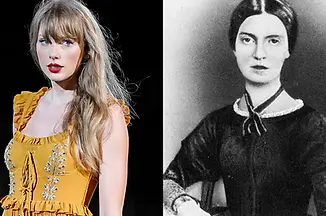
Emily Dickinson and Taylor Swift may be sixth cousins (Hatcher, 2024), but they have a lot more in common than distant family ties. Dickinson wrote about the elusive and terrifying nature of fame. Swift writes about the suppression and isolation she feels while existing in the public eye. Taylor Swift lives a life that her distant cousin Emily Dickinson both coveted and rejected, and Swift has her own complex feelings about the fame in which she operates. While more than 100 years separate the two writers, themes present in each of their pieces suggest the women share similar attitudes and narratives about the fleeting, restrictive, and seductive nature of fame – and what it means for their body of work...

Maria Hernandez
Lone Star College - Kingwood
This study investigates the potential of cinema in shaping public perceptions of astronomical phenomena by analyzing The Black Hole (1979) and Interstellar (2014), with an aim to explore the films’ impact on popular scientific understanding and public engagement with black holes. Although black holes began capturing theatergoers’ attention in the 1970s, evoking both fascination and fear, particularly with the release of Disney's The Black Hole (1979), such responses resulted the limited knowledge available...

Nixon Gorka
The University of Texas at Tyler
As the Cold War came to a close, MI6 Deputy Chief Sir Gerry Warner was asked how he would describe the role of Britain’s foreign intelligence service to Queen Elizabeth II. The career intelligence officer answered rather starkly, telling the man opposite him that Britain’s foreign intelligence apparatus was “the last penumbra of empire.”...