


FALL 2025
Dwelling in Possibility (Emily’s Version)
Ashleigh Lawrence
University of Houston

Ashleigh Lawrence recently graduated from Brazosport College, where she was honored with the Regents Scholar award for her work in the Honors Program. She presented her work at both the Great Plains Honors Council Conference and the Gulf Coast Collegiate Consortium Academic Symposium in 2025. She is currently pursuing a bachelor’s degree in political science at the University of Houston.
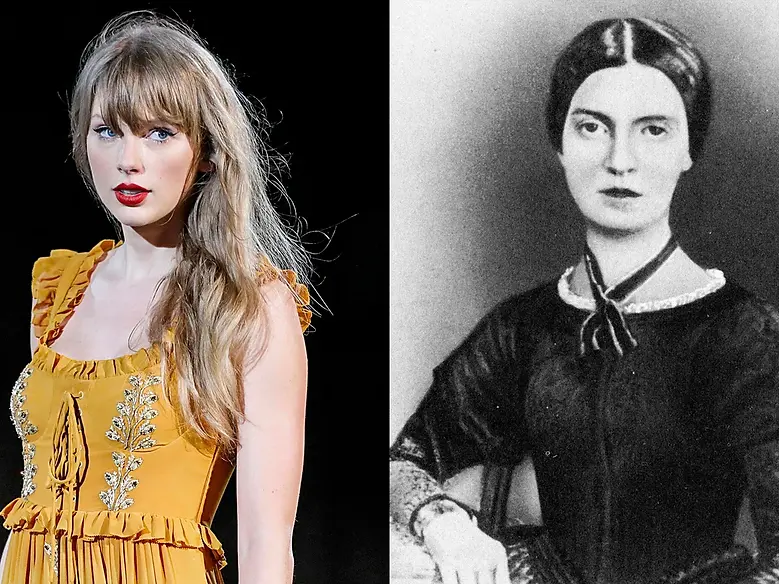
Emily Dickinson and Taylor Swift may be sixth cousins (Hatcher, 2024), but they have a lot more in common than distant family ties. Dickinson wrote about the elusive and terrifying nature of fame. Swift writes about the suppression and isolation she feels while existing in the public eye. Taylor Swift lives a life that her distant cousin Emily Dickinson both coveted and rejected, and Swift has her own complex feelings about the fame in which she operates. While more than 100 years separate the two writers, themes present in each of their pieces suggest the women share similar attitudes and narratives about the fleeting, restrictive, and seductive nature of fame – and what it means for their body of work.
Dickinson’s common themes of love, nature, and death are well established in the public psyche, but another topic Dickinson sometimes visited was the concept of fame. While fame was not something that Dickinson knew during her lifetime, it appears to have been self-imposed in a purposeful manner. Paul Crumbley writes, “In her June 1862 letter to Higginson, she famously responds… “If fame belonged to me, I could not escape her” (Crumbley, 162). In Poem 1507, Dickinson seems to address the idea that fame requires constant reinvention and injections of new energy into the public eye – which she appears unwilling to provide on anyone’s terms but her own. With the final stanza of “Electrical the embryo, But we demand the Flame”, Dickinson describes a short-term life span for the embodiment of celebrity that is only worthwhile at its peak. This concept ties back to the first stanza that the occupant of fame must die or ascend incessantly.
Similarly, Swift has addressed this concept in several of her songs, which are known to be personal expressions of her life and her experiences. Swift signed her first record contract at the age of 15. Her debut album was released when she was just 16 years old and had endless possibilities in front of her. By age 21, she was arguably one of the biggest stars in the music industry and an icon for a generation. And yet, the negative ideals of fame were already becoming present in her fourth studio album, Red (2012). Swift’s song “The Lucky One” outlines the rise and disappearance of a star before Swift’s time in the spotlight. Swift performed “The Lucky One” on April 2 nd , 2023, in Arlington, Texas during an acoustic portion of her tour set, and prefaced with a surprisingly candid introduction, “This song is about how horrible being famous is”. Swift writes,
“And your secrets end up splashed on the news front page
And they tell you that you’re lucky, but you’re so confused
'Cause you don’t feel pretty, you just feel used
And all the young things line up to take your place
Another name goes up in lights, you wonder if you’ll make it out alive”
(Swift, 2012).
While Swift has been known to periodically write about personas other than herself, her point of view is still very clearly her own. In “The Lucky One”, her tarnished ideas of fame come through the lyrics she writes. Though she is speaking about another, the detrimental ideas of fame can be transferred and applied to Swift herself. Swift goes on to hint at the uneasy future of her own status in the last line of the verse.
While Dickinson was able to use her isolation to the benefit of her sense of creative control, Swift has been able to evolve her art, genre, and style thanks in part to the collective power of her fanbase. While Swift appears to have enjoyed her foray into various genres, she is acutely aware of the patriarchal slant of the industry in which she finds herself – and the expectations of the public eye – should she decide she wishes to continue in the spotlight. In the Netflix documentary Miss Americana, Swift states, “It’s a lot to process because we do exist in this society where women in entertainment are discarded in an elephant graveyard at 35…the female artists have to remake themselves, like, 20 times more than the male artists or else you’re out of a job” (Wilson, 2020). Swift is aware of her power, but she also seems aware that it could end at any moment. The question then becomes, how long will Swift be willing to transform herself in the public eye – and whether those transformations continue to align with her desires for her own personal growth.
Unlike Swift, Dickinson is able to reinvent or restructure her work as she pleases without concern to how it may impact her celebrity status. In “Poem 466”, Dickinson uses the symbolism of a home without windows to connotate the stifled air Dickinson feels when considering the work of prose – that is, using ordinary language as opposed to the literary devices we see her use in her poetry. Nancy Walker explains, “If ‘prose’ represented for Dickinson all that was dull or conventional – a prison of conformity – poetry represented the opposite: freedom, individuality, originality” (Walker, 58). It’s clear from Dickinson’s expressions of her narrow hands gathering “paradise” from the well-windowed house of poetry, that she prefers to work at her own discretion and pleasure. She prefers to write when inspiration strikes and prefers to use the language of nature streaming through her open windows. To this end, Dickinson – once again – prefers the freedom of her craft without the scrutiny of the public eye.
Unlike Dickinson, who purposely avoided the spotlight, Swift has spent the majority of her life in the public eye. In 2020, amid the Covid-19 pandemic, Taylor Swift released two albums that marked another genre shift. “folklore” and “evermore” were released five months apart in the summer and late fall of 2020. The sister albums are subdued, romantic, and achingly personal. The final song on “folklore” – The Lakes – offers Swift’s plaintive perspective on feeling isolated from her celebrity and wonders at whether she wishes to return to it. The lyrics were inspired by a visit to the Lake District in Northwest England, a region famous for being the isolated home of several 19 th century English Romantic poets. Swift describes, “I went to Willam Wordsworth’s grave and just sat there, and I was like, wow you went and did it. You went away and you kept writing, and you didn’t subscribe to the things that were killing you” (Swift, Folklore: The Long Pond Studio Sessions). The lyrical content of these albums turns toward the language of lyrical poetry, and away from the language of lyrical prose. Swift took forced isolation as an opportunity to experiment with her writing, as her isolation gave her the sense of creative freedom Dickinson held – and was unwilling to relent – by inviting more than her closest personal relationships into her work.
In one of her more well-known works, Poem 260, Dickinson proudly proclaims herself as a “Nobody” – a title that could not be bestowed upon Swift today or likely any day in the future. When Dickinson relates the idea of being famous to being a croaking frog perched in a single spot without the freedom to leave – an image that Swift no longer appears to fit – it strengthens the notion that Dickinson had little to no interest in being an active participant of fame. However, I believe that this argument is undermined by other works like “Poem 1788”. Dickinson writes,
“Fame is a bee.
It has a song—
It has a sting—
Ah, too, it has a wing”
(Dickinson).
Dickinson has several poems about bees, and she appears to revere them and their role in nature. In Poem 1788, Dickinson again addresses the notion of the fleeting nature of fame. It is here that some of her more complex feelings of celebrity are laid bare. The bee that she admires continues its work, and Dickinson does not interact or interrupt it, lest she catch the sting. She misses the charming song of the bee when it flies away. It is a long winter for Dickinson before the bee–and her fleeting desire to pursue fame – returns.
While there is a lot that can be said about Swift without bringing up the public battle for her master recordings, the very public battle mirrors a situation Dickinson appears to have feared more than any notion of being a somebody. In Swift’s original contract with Big Machine Records, the record label retained ownership rights to the master recordings of Swift’s work. After Swift’s contract expired, she was unable to purchase the rights to the recordings – despite having the financial ability to do so – her work was sold out from under her to Scooter Braun, with whom she did not have a cordial business or personal relationship with. As Ann Herman explains, “An artist’s ownership of her masters also reflects the personal ties she has to her work. Because art is expressive, many artists feel their work is more than just a completed piece, but that it is a part of themselves and reflects who they are” (Herman, 250). Although Swift was able to find a way to reclaim her work through re-recording and releasing her “Taylor’s Version” of albums, Swift was living out the exact scenario of which Dickinson appeared to be so afraid. Dickinson appears to have prized the creative freedom she felt within her work above any fleeting desire for fame. Her work is representative of her ideas of self and the carefully controlled world in which she lives. In essence, her work was kept as “Emily’s Version”. Dickinson only surrenders control of her work in her death.
In Dickinson’s lifetime, she rejected opportunities to bring public attention to her work, but it was meticulously kept and organized for the event that her work was discovered after her death. Interestingly, it was her choice of privacy that posthumously rocketed her to the fame she never knew in her lifetime. Swift’s work has been able to live concurrently with the artist’s fame and will continue to outlive her. Swift’s ability to regain control over her body of work throughnher “Taylor’s Version” strategy is remarkable and unique. Dickinson fans parse the lines of poetry searching for meaning, and Swift fans do the same to the lyrics of her work. Dickinson has never been able to interpret her poetry for her global audience, and Swift often does not explicitly interpret her own work to hers, particularly work that refers to her personal relationships. Fans of both are able to draw their own conclusions and form personal relationships with their interpretations of the text. Without direct interpretation of the bodies of work, the verse of both artists is left to dwell in fame – and in possibility.
REFERENCES
Crumbley, Paul. “'Fame’s Consummate Fee’: Dickinson’s Nameless Celebrity.” Iperstoria, no.9, June 2017. EBSCOhost, https://doi-org.plainview.brazosport.edu/10.13136/2281-4582/2017.i9.241.
Dickinson, Emily. “Fame Is a Bee.” Scholastic Scope, vol. 69, no. 3, Nov. 2020, p. 24.EBSCOhost, research.ebsco.com/linkprocessor/plink?id=51b46526-a47b34d3-8e73-dfeb5092aa50.
Dickinson, Emily. Fame is the One that Does Not Stay (1507). n.d.<https://www.poetryfoundation.org/poems/56826/fame-is-the-one-that-does-not-stay1507>.
Dickinson, Emily. “I Dwell in Possibility.” American Poet, vol. 36, Mar. 2009, p. 49.EBSCOhost, research.ebsco.com/linkprocessor/plink?id=8e7db788-b562 3c21-8e39-155a327bfd56.
Folklore: The Long Pond Studio Sessions. Dir. Taylor Swift. Perf. Taylor Swift. Netflix, 2021. Musical Performance Film.
Hatcher, Kirsty. “Taylor Swift and Poet Emily Dickinson Are Related, Ancestry Reveals.” People.Com, Mar. 2024, p. N.PAG. EBSCOhost,research.ebsco.com/linkprocessor/plink?id=f688f01d-289d-3646-b0dd-15d19391823a.
Herman, Ann. “You Belong with Me: Recording Artists’ Fight for Ownership of Their Masters.” Northwestern Journal of Technology & Intellectual Property, vol. 18, no. 2, Mar. 2021, pp. 239–63. EBSCOhost, research.ebsco.com/linkprocessor/plink?id=30972ca2-0490-3f2c-b791-977782361b3e.
Swift, Taylor. YouTube.com. 11 11 2021. 26 11 2024.
https://youtu.be/4LtQxA_ooLk?si=KDvHrGpa8S_9AjSL&t=70
Walker, Nancy. “Emily Dickinson and the Self: Humor as Identity.” Tulsa Studies in Women’s Literature, vol. 2, no. 1, Apr. 1983, pp. 57–68. EBSCOhost, https://doi-org.plainview.brazosport.edu/10.2307/464206.
Miss Americana. Dir. Lana Wilson. Perf. Taylor Swift. Netflix, 2020. Film.
Author’s note: This paper was drafted, written, and presented prior to May 30 th , 2025 – the date
Taylor Swift announced she now retains full ownership of her master recordings. Finally.
CONTINUE READING

Andrea Castro
Lone Star College
While previous studies tend to mention Cynthia Ann Parker merely as a footnote in the biography of her son, Quanah Parker, this research aims to highlight her historical significance by focusing on her second capture, exploring Parker’s often-overlooked experience as opposed to those of her more commonly studied male contemporaries. This research first examines the work of Paul H. Carlson and Tom Crum, and what their historiography has established about the manipulation of Cynthia Ann Parker’s story, arguing it was exploited to propel Captain Sullivan Ross’ political career. Then, a primary source analysis of various reports written by Ross about the “battle” at Pease River, where Parker was captured, indicates major inconsistencies in the incident’s narrative...

Maria Hernandez
Lone Star College - Kingwood
This study investigates the potential of cinema in shaping public perceptions of astronomical phenomena by analyzing The Black Hole (1979) and Interstellar (2014), with an aim to explore the films’ impact on popular scientific understanding and public engagement with black holes. Although black holes began capturing theatergoers’ attention in the 1970s, evoking both fascination and fear, particularly with the release of Disney's The Black Hole (1979), such responses resulted the limited knowledge available...

Blythe Meacham
Angelo State University
The novel follows the downfall of the di Loredani family, whose members, after the arrival of the knave Count Ardolph, descend into murder, adultery, and thievery. Victoria de Loredani especially, under the influence of the servant – and her eventual lover – Zofloya, falls into a life of vice, taking on the role of the Gothic villain in the story. She engages in seduction, imprisonment, and murder until Zofloya, now revealed to be the devil in disguise, drags her soul to hell for eternity. Readers were both enthralled and scandalized by such topics, particularly when written by a woman...