


FALL 2025
Beyond the Event Horizon: Exploring Black Holes in Science, Film, and Society
Maria Hernandez
Lone Star College - Kingwood

Maria Hernandez is an Honors student and leader at the Honors College of Lone Star College–Kingwood. An aspiring astrophysics major, Maria has been fascinated by space since childhood. Her academic passions include black holes, the origins of the universe, and the deeper mysteries of the cosmos. She also enjoys writing, reading, and exploring new ideas. Beyond academics, Maria is driven by her commitment to women's rights, Latino community well-being, and animal welfare—including advocating for endangered species and ethical treatment of animals. One day, she hopes to publish a book, but her ultimate dream is to work at NASA and contribute to discoveries that expand our understanding of the universe.

ABSTRACT
This study investigates the potential of cinema in shaping public perceptions of astronomical phenomena by analyzing The Black Hole (1979) and Interstellar (2014), with an aim to explore the films’ impact on popular scientific understanding and public engagement with black holes. Although black holes began capturing theatergoers’ attention in the 1970s, evoking both fascination and fear, particularly with the release of Disney's The Black Hole (1979), such responses resulted the limited knowledge available. Few studies compare the ways in which scientific accuracy in film influences public perceptions of astronomical phenomena. To address the impact of film on popular knowledge, this research integrates a comparative content analysis, drawing on the perspectives of physicist Kip Thorne, film scholar David Kirby, philosopher David Johnson, and historian Bina Nir. A synthesis of the films’ visual effects, scientific dialogue, narrative accuracy, and statistical data on audience preferences for realism versus entertainment suggests that films are not only vital tools for confirming the existence of scientific phenomena but also for communicating complex scientific ideas to a broad audience. Disney’s The Black Hole illustrates how even inaccurate scientific depictions can provoke interest and debate, suggesting that representations, regardless of fidelity, contribute to scientific dialogue and curiosity. Conversely, Interstellar, which involved collaboration with scientists to achieve higher accuracy in its interpretation, demonstrates the potential of films to profoundly influence public understanding and attitudes toward science. Future research could expand this study by exploring fictional depictions of other astronomical phenomena beyond black holes, such as the portrayal of wormholes in Carl Sagan's Contact and Dan Simmons’ novel series Hyperion Cantos.
The enigma of black holes emerged from a time steeped in historical significance. In 1915, the world was engulfed in the horrors of World War I, a conflict that left a profound mark on global history. Amidst this turmoil, Albert Einstein, acutely aware of the cataclysmic events unfolding around him, was formulating the Theory of Relativity, a scientific breakthrough that starkly contrasted the destruction that surrounded him.
Karl Schwarzschild, Einstein’s colleague, found himself amid the conflict, a Jewish man in a world tainted by anti-Semitism. Schwarzschild ran a weather station in Belgium, calculated shell trajectories with an artillery battery in France in late 1915, and found himself on the Eastern Front, ill with blisters in his mouth. The ravages of sickness failed to dim his intellectual fervor; instead, they fueled his relentless pursuit of scientific inquiry with an intense concentration on physics.
Back in Berlin, Schwarzschild had learned that Albert Einstein was working on a revolutionary new theory of gravity. When he realized that Einstein had presented this theory in four lectures in November 1915, he obtained and devoured a written abstract. Schwarzschild outlined the first known solution to Einstein’s field equations that accurately explained space- time deformation around a spherical object like a planet or a star. Since his theory was still too complicated to explain, it was a shock to Einstein when he read the letter from Schwarzschild for the first time; he went so far as to write, “I did not expect that the exact solution of the problem could be formulated in such a simple way.”
Lying in his hospital bed, Schwarzschild further realized that if a star’s mass were compressed into a smaller and smaller volume, the valley of space-time around it would become steeper and steeper until, eventually, it would become a bottomless pit from which nothing, not even light, could escape. At the time, no one knew that the term they were looking for was “black hole.”
The war did not end with this discovery, and it did not end later, when Einstein’s magnum opus was published on November 25, 1915, with the concise title “The Field Equations of Gravitation.” Its veracity took years, even after those phantasmagoric nights in the middle of a war, to materialize. Scholars like Arthur Eddington, an astronomer, physicist, and mathematician, recoiled at the notion that stars could collapse into the gravitational abyss of black holes—a concept seemingly at odds with the laws of nature. Eddington was also the first expositor of the theory of relativity in English, playing a critical role in both understanding and disseminating these complex ideas, bridging the gap between scholarly dialogue and public curiosity.
This growing intrigue in the mysteries of the cosmos and the laws that govern it soon found a new avenue for exploration and dissemination: cinema. Since the advent of cinema in the 1920s, questions have persisted regarding the potential influence of films on public understanding and attitudes, particularly towards scientific subjects. A notable early example is the 1920 film “The Basic Principles of Einstein's Theory of Relativity.” Despite being released in an era devoid of educational films, it attracted significant attention within the German community. It was directed by Hanns Walter Kornblum, a German filmmaker who aimed to present “entire scientific fields and theories of general interest in a logically structured and comprehensible way.”
The film, centered on Einstein's Theory of Relativity, was structured to elucidate this novel scientific concept to the German public. Comprising three parts, it delved into the principle of relativity, the wave theory of light and experimental evidence challenging it, and finally, how Einstein's theory resolved these difficulties.
The reactions to the film were divided into two groups of people, according to the director himself: “[t]he first group has never read about Einstein or the results of his research, and the second group has only read a little about the subject and has not yet understood the little they have read. This film is presented as an understandable but comprehensive commentary for both groups.” Despite being a relatively new concept, the German public’s response was extraordinarily enthusiastic, far exceeding that usually accorded to educational films, which were generally not reviewed in the daily press. Nevertheless, despite the enthusiastic reception from certain quarters, criticisms also emerged, with scholars who argued against the necessity of cinematic representation for scientific concepts, citing the precision of mathematical explanations. Milena Wazek, a historian of science, in her research about this particular film and the reaction to German culture, divided the participants of this public argument into four groups: “(1) people belonging to the film industry and cultural sector; (2) laymen who were interested, for whatever reason, in Einstein’s theory of relativity; (3) scientists and academics who expressed their views on this attempt to popularize modern physics; and (4) opponents who were mainly politically motivated.”
This film, however, was instrumental in shedding light on Einstein's new theory and significantly contributed to its popularity among the German community. Still, it also caused an exhausting ongoing battle in which even religious perspectives played a part. For decades, the prevailing assumption held steadfast: stars, the celestial beacons that dot our night sky, would resist the inexorable pull of gravitational collapse, shunning the dark embrace of black holes, a misconception held in scientific and nonscientific communities. To many, black holes remained enigmatic specters—entities relegated to the realms of magic or science fiction or even the Devil, existing beyond the bounds of tangible reality. It is not easy to accept that something is out there that bends space and time and has a gravitational force so strong that not even light can escape it. In confronting the enigma of black holes, humans have encountered the erratic nature of existence—a testament to the profound mysteries shrouded in the cosmic tapestry. These enigmas and the public perception of this new astronomical knowledge –even if it has changed throughout the years, are still somewhat new. But, through films, the idea has become slightly more digestible.
The intersection of cinema and complex scientific discoveries, particularly in physics, has become increasingly prominent over recent decades. Despite this growing trend, few scholars have thoroughly explored the intricate relationship between cinematic representations, scientific understanding, and cultural reception. This paper contends that films, more particularly The Black Hole (1979) and Interstellar (2014), play a crucial role in shaping public understanding and attitudes toward scientific phenomena, predominantly black holes. Likewise, by conducting a detailed analysis of audience responses and societal discourse surrounding these films, this research examines how the cinematic portrayals of black holes have increased public interest in this astronomical phenomenon and significantly influenced the layperson’s understanding of complex scientific concepts. Through their visual and narrative interpretations, these films bridge the gap between abstract scientific theories and popular culture, thereby molding how society perceives and engages with the mysteries of the universe. This analysis aims to underscore the power of cinema as a medium to reflect and shape scientific awareness and thinking, revealing the reciprocal relationship between science and film in the modern world.
The intersection of science and cinema holds profound significance, extending beyond mere entertainment to shape both science communication and cultural understanding. Cinematic portrayals of scientific concepts can potentially influence public perceptions, attitudes, and even policy decisions regarding science and technology. By presenting complex ideas in accessible and visually compelling ways, films bridge the gap between scientific academia and the general public, fostering interest and curiosity in scientific inquiry. Moreover, these portrayals contribute to cultural narratives and collective imagination, reflecting societal values, fears, and aspirations. However, the impact of cinematic representations extends beyond scientific accuracy, often intersecting with broader cultural discourses and ideological frameworks. Thus, exploring the significance of this intersection offers valuable insights into the dynamic relationship between science, cinema, and society, illuminating the complexities of knowledge dissemination and cultural production in the modern era.
1 Andrea Estrada, “World War and Relativity,” The Current, November 5, 2019, https://news.ucsb.edu/2019/019697/world-war-i-and-relativity
2 Marcus Chown, “The incredible story of how we discovered black holes,” Science Focus, May 15, 2019, https://www.sciencefocus.com/space/the-incredible-story-of-how-we-discovered-black-holes
3 “KARL SCHWARZSCHILD.” Publications of the Astronomical Society of the Pacific 28, no. 166 (1916): 269–73. http://www.jstor.org/stable/40691972.
4 “Schwarzschild’s war.” Institute of Physics. Accessed March 15, 2024. https://spark.iop.org/schwarzschilds-war
5 “KARL SCHWARZSCHILD.” Publications of the Astronomical Society of the Pacific 28, no. 166 (1916): 269–73. http://www.jstor.org/stable/40691972.
6 Kip Thorne, The Science of Interstellar, rev. ed. (W.W. Norton & Company, 2014), 58—68.
7 Jeremy Schnittman, Ä brief history of black holes,” Astronomy, August 29, 2019, https://www.astronomy.com/science/a-brief-history-of-black-holes/
8 Milena Wazeck, “The 1922 Einstein Film: Cinematic Innovation and Public Controversy,” Phys. Perspect. 12, 163–179 (2010), https://doi.org/10.1007/s00016-009-0008-7
9 Ibid.
10 Ibid.
11 Oskar Kalbus, The German educational film in science and teaching (Berlín: Carl Heymanns Verlag, 1922), p. 39.
12 Wazeck, “The 1922 Einstein Film.”
13 Francis Reddy, “What Are Black Holes?” NASA, September 8, 2020, https://www.nasa.gov/universe/what-are- black-holes/
14 David A. Kirby, “Science Consultants, Fictional Films, and Scientific Practice.” Social Studies of Science 33, no. 2 (2003): 231–68. http://www.jstor.org/stable/3183078.
15 Kirby, “Science Consultants, Fictional Films, and Scientific Practice.”
16 Ibid.
1
2
3
4
5
6
7
8
9
10
11
12
13
14
15
16
CRITIQUING SCIENCE FICTION
In discussion of the intersection of science fiction and the understanding of astronomy, Kip Thorne, an American theoretical physicist known for his contributions to gravitational physics and astrophysics, underscores the critical role of films in popularizing complex scientific ideas. As a scientific consultant and executive producer for Interstellar (2014), Thorne facilitated the integration of accurate scientific details into the film's narrative, enhancing its educational value while preserving its entertainment quality. Thorne believes such cinematic endeavors ignite public interest in physics and serve as a vital educational tool by visually simulating otherwise abstract and inaccessible concepts.
Additionally, David K. Johnson, a philosophy professor at King’s College with expertise in logic, scientific reasoning, metaphysics, and the philosophy of religion, observes the tendency of science fiction enthusiasts to critique films for plot holes and scientific inaccuracies. He states, “From plot holes to scientific accuracy if there’s something wrong with a science fiction film, they’re likely to tell you about it.” In his article, he delves into the physics of black holes and offers a valuable comparison of the science behind two relevant films: Interstellar (2014) and The Black Hole (1979). Additionally, Johnson’s critique of the depiction of entering a black hole in both films, addressing the idea of "spaghettification," prompts consideration of how such inaccuracies may influence public perceptions and misconceptions about the nature of black holes. But he insists that, as for the case of black holes, we are still learning from them.
Therefore, the mistakes are inevitable.
17 Kip Thorne, The Science of Interstellar, rev. ed. (W.W. Norton & Company, 2014), 58—68.
18 David Kyle Johnson, “Understanding Black Holes Through Science Fiction,” Sci Phi Journal, June 19, 2019, https://www.sciphijournal.org/index.php/2019/06/19/understanding-black-holes-through-science-fiction/.
19 Johnson, “Understanding Black Holes.”
20 Ibid.
17
18
19
20
EXPLORING RELIGIOUS SYMBOLISM AND SCIENCE IN CINEMA
On the other hand, some scholars explore the intersections of popular culture, religious symbolism, and scientific inquiry, offering intriguing perspectives on the multifaceted connections embedded within cinematic narratives. Bina Nir, a lecturer at the Yezreel Valley College and the Department Head of the Honors B.A., wrote a journal article in 2020 called “Biblical Narratives in INTERSTELLAR.” In this piece, she argues about the possible biblical narratives in the movie Interstellar, stating that “the film is also replete with biblical narratives such as the apocalypse, Noah’s ark, the tale of the spies, prophecy and the tasking of the “chosen” one with a mission, signs, and miracles, the ability to control nature and to create elements within it, and the idea of punishment in the form of being denied entrance to the promised land.” Bina Nir researched the film's arguments, starting with the definition of black holes and their possible significance in popular culture, even more so in a biblical context. She states, “Human thought proceeds according to patterns we have grown into, but because they are often invisible to us, we are unaware of them. Our attempts to understand the physical world around us may be made in keeping with patterns that we have absorbed through our culture.” This approach underlines that while the film employs religious motifs, it remains anchored in scientific exploration, particularly in its portrayal of black holes and interstellar travel. This melding of science with spiritual and cultural elements illustrates the multidimensional ways cinema can communicate complex scientific ideas to a broad audience.
21 Bina Nir, “Biblical Narratives in INTERSTELLAR (Christopher Nolan, US/GB 2014),” Journal for Religion, Film and Media, Jg. 6 (2020), Nr. 1, S. 53-69, http://dx.doi.org/10.25969/mediarep/19515.
22 Ibid.
23 Nir, “Biblical Narratives in INTERSTELLAR,” 17.
21
22
23
PROMOTING SCIENTIFIC LITERACY THROUGH POPULAR CULTURE
Connecting popular culture and science, particularly astronomy, is challenging. Although not inherently impossible, the seamless integration of these two realms often proves daunting. Many argue that common themes between them are minimal, perpetuating ongoing debates due to the intricate nature of these beliefs. As A. Bowdoin Van Riper, a historian, researcher, and educator with a strong science background, asserted, “Popular culture probably does more than formal science education to shape most people's understanding of science and scientists.” Its pervasive nature, coupled with its eye-catching appeal, renders it more memorable in the public consciousness. However, amidst the richness of cultural representations, achieving a better grasp of basic science remains a shared aspiration. The challenge lies in fostering a society where individuals can discern instances of dramatic license taken with the laws of nature. David A. Kirby, the Robert O. Lawton Distinguished Professor of English at Florida State University, is one of the scholars who argues that “[f]ilm not only has the ability to act as a virtual witnessing technology but also forces consensus on the public version of scientific debates by presenting a single vision of nature in a perceptually realistic structure.” His insightful research argued that films can have a positive impact if they are done correctly. This study engages with this controversy by analyzing how films contribute to or complicate public understanding of astronomy. Specifically, it examines these cinematic works’ dual role in advancing scientific literacy and perpetuating certain scientific myths or misconceptions. By evaluating the scientific accuracy of these films and their reception by both critics and the general public, the research aims to discern how effectively cinema bridges the gap between complex astronomical concepts and popular cultural understanding. This analysis contributes to the broader dialogue about the role of media in science education. It offers insights into how filmmakers can improve the educational value of science-based movies without sacrificing their artistic integrity, notably The Black Hole and Interstellar.
24 A. Bowdoin Van Riper, “What the Public Thinks It Knows About Science.” EMBO Reports 4, no. 12 (December 1, 2003): 1104–7. https://doi.org/10.1038/sj.embor.7400040.
25 Joachim Allgaier and Hauke Riesch, “Science in Society: From Elite Media to Mass and Entertainment Culture. Conference Report of #POPSCI2015: Science, Research, and Popular Culture” ResearchGate, December 14, 2015, https://www.researchgate.net/publication/299229858
26 Kirby, “Science Consultants, Fictional Films, and Scientific Practice,” 231.
24
25
26
THE BLACK HOLE (1979)
The 1970s marked profound change and uncertainty in the United States, with significant political and social changes, alongside technological and scientific advancements. Among the fields experiencing notable progress was physics, with the consolidation of quantum field theory and groundbreaking discoveries by figures like Stephen Hawking, particularly regarding black holes and the Big Bang Theory. The discovery of the first widely accepted black hole, Cygnus X-1, by Paul Murdin, a British astronomer, and his colleagues in 1971 marked a turning point in astrophysics, providing convincing evidence for the existence of black holes. This sudden shock about the Universe attracted the attention of some people around the world. As always, the mystery of the unknown aroused curiosity among scientists and non-scientists. For this reason, in 1979, screenwriters Bob Barbash and Richard Landau proposed the idea of a space catastrophe movie tentatively titled Space Station One to Frank Paris, executive story editor at Disney Studios. This idea is known today as The Black Hole, which many people agree was for many people, including even scientists, “the first time they remember ever hearing about black holes.”
27 Ashish Arora et al., “The Changing Structure of American Innovation: Some Cautionary Remarks for Economic Growth,” Innovation Policy and the Economy 20 (December 1, 2020): 39–93, https://doi.org/10.1086/705638.
28 “Stephen Hawking Estate,” n.d., Accessed March 7, 2024, https://www.hawking.org.uk/biography.
29 “Cygnus X-1 Fact Sheet - StarDate’s Black Hole Encyclopedia,” n.d., Accessed March 15, 2024, https://shorturl.at/E7mhW
30 Wikipedia contributors, “The Black Hole (1979 Film),” Wikipedia, April 16, 2024, https://shorturl.at/pHzLt.
31 Carla Ra, “Interstellar Vs. Disney’s the Black Hole,” Carla Ra (blog), September 1, 2022, https://www.authorcarlara.com/post/interstellar-vs-disney-s-the-black-hole.
27
28
29
30
31
PLOT SUMMARY
Set in the distant future of 2130, The Black Hole follows the journey of a spacecraft crew who encounter a massive, seemingly deserted ship on the edge of a black hole. The crew aboard the spaceship USS Palomino consists of Captain Dan Holland, First Officer Lieutenant Charlie Pizer, journalist Harry Booth, ESP-sensitive scientist Dr. Kate McCrae, the expedition’s civilian leader Dr. Alex Durant, and the tiny robot V.I.N.CENT. (“Vital Information Necessary CENTralized”). They encounter the lost ship, USS Cygnus, strangely unaffected by the black hole's gravitational pull. They investigate and find the USS Cygnus populated by Dr. Hans Reinhardt, one of Earth’s most brilliant scientists, and his army of robots. Reinhardt reveals that he and Dr. Kate’s father were the only ones who stayed behind after a meteor shower damaged the ship, and he has since turned the crew into humanoid robots to help him with his research. As the crew members split up to repair their vessel and explore Cygnus, they uncover the truth about Reinhardt's sinister intentions and past actions: the robots were actually what was left of the human crew that was with him but were mutinied when Reinhardt refused to return to Earth after the ship was damaged. With the help of a sympathetic robot named B.O.B., they devise a plan to escape and confront Reinhardt.
Despite facing numerous obstacles, including Maximillian, Reinhardt’s formidable red robot, the crew manages to overpower their adversaries and escape on a probe ship. As the black hole consumes Cygnus, the crew finds themselves on the other side, on a journey toward an unknown destination. In the depths of the black hole, Reinhardt and Maximillian transform, merging into a single being. At the same time, the crew emerges on the other side, guided by a mysterious bluish-white light towards a distant planet, leaving behind the chaos and destruction of Cygnus and the black hole.
32 The Black Hole. Gary Nelson, Walt Disney Productions, 1979.
33 Ibid.
34 Ibid.
35 Megan, “Review: Disney’s the Black Hole (1979) — Disnerd Movie Challenge,” Disnerd Movie Challenge, May 7, 2021, https://disnerdmoviechallenge.com/blog/review-the-black-hole-dmc-71.
32
33
34
35
SCIENTIFIC ACCURACY
Upon its release, The Black Hole received mixed reviews from critics. While some praised its stunning visual effects and ambitious storytelling, others criticized its convoluted plot and lack of scientific accuracy. In a review made in 1979, Roger Ebert acknowledged the film's attempts to grapple with complex scientific concepts. Still, he found it lacking in coherence, stating that “the possibilities are mind-boggling,” but he lamented the film's failure to capitalize on its potential. Ebert mentioned that one of these possibilities is “much favored by science- fiction writers, is that black holes are tunnels in space and that if we fell into one, we might emerge (a bit scorched, perhaps) from a ‘white hole’ somewhere else in the universe.”
One prevalent misconception perpetuated by the film, both then and now, is the belief that black holes serve as portals for transportation, a notion often conflated with wormholes and time travel. Despite the film's attempt to popularize the concept of black holes, it also propagated inaccuracies that drew criticism from scientists like Neil deGrasse Tyson—American astrophysicist and writer—, who said The Black Hole is one of worst representations of science fiction, not only because it is a bad movie, but because it “didn't quite understand any of the interesting science about black holes.” This criticism is particularly poignant because black holes are centers of intense scientific interest due to their extreme gravitational effects, the bending of spacetime, and their role in testing the limits of Einstein’s theory of general relativity. Tyson’s comments highlight a missed opportunity to explore and demystify real scientific phenomena, which could have enriched the narrative and educated the audience about the true nature of black holes rather than perpetuating misconceptions. This oversight showcases the ongoing challenge in science fiction filmmaking: to balance the allure of dramatic narrative with the rigors of accurate scientific depiction.
Scientifically, The Black Hole takes liberties by portraying these enigmatic entities, simplifying complex concepts, and exaggerating gravitational effects for dramatic effect. This departure from scientific accuracy has been a point of contention among astrophysicists and science enthusiasts. One of the main inaccuracies lies in the film's description of the event horizon, the limit beyond which nothing, not even light, can escape the gravitational pull of the black hole. In The Black Hole, the event horizon is depicted as a visually striking vortex, resembling a whirlpool in space. However, this depiction oversimplifies the complex nature of black holes and fails to convey their actual gravitational effects, such as time dilation, where time near the event horizon slows drastically due to intense gravity; gravitational redshift, involving the stretching of escaping light into longer wavelengths; and spaghettification, where extreme tidal forces elongate objects as they fall towards the singularity. Critical to the physics of black holes, these effects highlight the discrepancies between cinematic portrayal and scientific accuracy.
Additionally, the film The Black Hole takes liberties with the concept of gravitational forces, portraying characters and objects near the black hole as experiencing extreme distortions in space-time. While gravitational forces near a black hole would indeed be significant, the film exaggerates these effects for dramatic purposes, sacrificing scientific accuracy. This portrayal is problematic because it can mislead the public about the nature of such cosmic phenomena, contributing to a widespread misunderstanding of fundamental scientific principles. When films sacrifice accuracy for spectacle, they risk creating lasting misconceptions that can affect how society perceives and engages with scientific realities, potentially influencing educational priorities and public policy regarding science.
Furthermore, The Black Hole introduces speculative ideas about the nature of black holes, including the notion that they are portals to other dimensions or even time travel devices. Although such concepts have captured the imagination of science fiction writers and audiences alike, they remain speculative and lack empirical evidence. The film’s conflating black holes with wormholes leads to significant public misconceptions about black holes. Misrepresenting black holes as gateways for time travel or interdimensional journeys not only distorts public understanding but also overshadows the real, scientifically verified phenomena associated with black holes, such as time dilation and spaghettification. However, despite these effects, black holes should not be mistakenly associated with time travel or intergalactic transportation. This misconception arises from the speculative notion that black holes could serve as portals to other dimensions or facilitate travel across vast distances in space. Such fallacies can hinder effective science communication and foster a skewed perception of physics, affecting both educational frameworks and the general public’s interest in and respect for scientific inquiry.
36 Roger Ebert, “The Black Hole,” January 1, 1979, https://www.rogerebert.com/reviews/the-black-hole-1979
37 Ibid.
38 “‘More Light…’ | the Black Hole (1979),” FictionMachine., May 25, 2020, https://fictionmachine.com/2020/05/25/more-light-the-black-hole-1979/.
39 Reddy, “What Are Black Holes?”
40 Chelsea Gohd, “What Happens When Something Gets ‘Too Close’ to a Black Hole?,” NASA, May 3, 2023, https://science.nasa.gov/universe/what-happens-when-something-gets-too-close-to-a-black-hole/
41 Ibid.
42 Gohd, “What Happens?”
43 Miguel Alcubierre, “Astronomy and Space on the Big Screen - Revista Mètode,” Revista Mètode, May 3, 2021, https://metode.org/issues/monographs/astronomy-and-space-the-big-screen.html.
44 Alcubierre, “Astronomy and Space.”
36
37
38
39
40
41
42
43
44
THEOLOGICAL THEMES
In addition to its scientific inaccuracies, the film delved into theological themes, intertwining them with its exploration of cosmic mysteries. Theological themes refer to ideas and narratives that explore the nature of God, the existence of a divine order, questions about the afterlife, and the moral implications of human and divine actions. These themes often address existential questions such as life's purpose, the universe's origins, and the relationship between humanity and the sacred. This intertwining of science fiction with theological inquiry reflects broader cultural engagements with religion and spirituality, especially significant considering the shifting American religious landscape. Surveys from the 1970s and '80s found that fewer than one in ten U.S. adults said they had no religious affiliation; however, a notable shift has occurred, with fully 23% now describing themselves as atheists, agnostics, “nothing in particular.” This change underscores the evolving public interest and the relevance of theological themes, as they offer a platform for audiences to explore deep existential questions in a changing religious context. Through symbolic imagery and thought-provoking dialogue, the film invites viewers to contemplate the nature of existence and humanity's place in the universe.
The film's incorporation of biblical motifs is evident throughout, with references to the story of David and Goliath serving as a recurring motif. Dr. Reinhardt, the enigmatic antagonist, likens the conflict between the crew and his robotic army to the biblical tale, casting himself as the formidable Goliath and the crew as the underdog David figures. This metaphor underscores the film's thematic exploration of power dynamics and the struggle against overwhelming forces.
One scene that encapsulates this theme occurs when the crew's robot companion, V.I.N.C.E.N.T., faces off against his militarized counterpart, Maximillian, in a tense confrontation. As Reinhardt watches, he remarks, “It's like David and Goliath, only this time, David is outmatched.” This dialogue reinforces the biblical parallel and highlights the existential stakes of the crew's battle against Reinhardt and the looming black hole. Furthermore, the film’s proposed alternate endings, including one featuring imagery of hell and spiritual symbolism, add depth to its exploration of theological themes. In one such ending, Dr. Reinhardt is depicted as a figure condemned to hell, suggesting a moral reckoning for his hubris and ambition. This provocative imagery challenges viewers to confront questions of morality and the consequences of human ambition in the face of cosmic mysteries.
The mixed reception of The Black Hole does not diminish its significant role in demonstrating cinema's capacity to evoke wonder and stimulate intellectual curiosity. While the film may take liberties with scientific accuracy, it successfully delves into existential questions and theological themes, encouraging viewers to ponder the profound mysteries of the cosmos. Although scientifically speculative, the portrayal of black holes in the film left a lasting impression on popular imagination. One key aspect of the film that fueled curiosity was its attempt to visualize what a black hole might look like and how it could theoretically affect time and space. Although not scientifically precise, these visual interpretations provided a tangible form to concepts that were primarily abstract to the general public. This visual depiction opened discussions and questions about the nature of black holes, spacetime, and the universe.
Additionally, the dramatic narrative surrounding the black hole’s powerful gravitational pull and its mysterious, all-consuming nature played into public fascination with what lies beyond the known universe. The film’s portrayal of a ship venturing close to a black hole taps into universal themes of exploration and fear of the unknown, mirroring humanity’s real-world fascination with exploring outer space. Furthermore, the use of a black hole as a central plot device introduced audiences to the concept of event horizons and singularities –even when inaccurately, it sparked interest in the physics behind these phenomena, but misconceptions fueled this interest. This impact is vividly captured by physicist and blogger Carla Ra, who observes, “The movie might have been quickly forgotten, but the black hole stayed. From then on, the whole world got the news that there could be a monstrous object in the sky that would trap anything inside it. And the image created in this Disney movie was associated with black holes for decades... until Interstellar.”
45 Alan Cooperman, “The Factors Driving the Growth of Religious ‘Nones’ in the U.S.,” Pew Research Center, April 14, 2024, https://www.pewresearch.org/short-reads/2016/09/14/the-factors-driving-the-growth-of-religious- nones-in-the-u-s/.
46 Ibid.
47 “Disney’s the Black Hole: David & Goliath in Space,” Reel World Theology, September 21, 2017, https://www.reelworldtheology.com/disneys-the-black-hole-david-goliath-in-space/.
48 Ibid.
49 The Black Hole. Gary Nelson, Walt Disney Productions, 1979.
50 Ra, “Interstellar Vs. Disney’s.”
51 Ibid.
45
46
47
48
49
50
51
INTERSTELLAR (2014)
Thirty-five years after The Black Hole’s release, both the scientific and cinematic realms have seen exponential progress. In late 1979, following the discovery of Cygnus X-1, the theory of relativity was confirmed, and concepts like black holes, wormholes, and space-time dilation started permeating Hollywood narratives. Stephen Hawking’s groundbreaking work has significantly shaped our understanding of black holes, sparking scientific and cultural interest in these cosmic phenomena.
While black holes were already a subject of fascination in both physics and science fiction, it was Hawking's contributions in the late 1960s that propelled them into mainstream consciousness. His seminal work, A Brief History of Time (1988), further popularized these concepts. Films and television shows from earlier decades often struggled to visually and conceptually represent black holes. As explored earlier in the example of The Black Hole, media representations frequently leaned towards dramatic and visually spectacular interpretations that sacrificed scientific accuracy for narrative excitement. This ongoing challenge reflects the broader difficulty of conveying cutting-edge scientific theories through popular media, which must balance the desire for entertainment with the need for factual integrity. The discrepancy between Hawking’s detailed, scientifically grounded descriptions and their cinematic portrayals underscores a persistent gap in public science education, one that filmmakers and educators continue to navigate.
Despite the flaws in portraying black holes, the public’s fascination with these celestial objects had only intensified. This growing awareness reflects broader societal shifts between the 1970s, since the first black hole was finally discovered, and the last decade, both scientifically and culturally. As interest in the mysteries of the universe expanded, it paralleled and even fueled significant developments in popular culture, particularly in the realm of science fiction. The genre emerged more prominently as one of the most dominant forces in media, bolstered by advancements in special effects technology and a burgeoning interest in scientific themes. Scholars argue that “science fiction is one of the most dominant genres of our time” because even when it was popularized in the past, it “has not been as influential in the culture as it is now.”
Recent studies of media consumption habits highlight a strong interest in science-related entertainment, especially within the science fiction genre. Although many viewers perceive these media primarily as sources of entertainment, their potential to influence public understanding of scientific concepts is also significant. According to the most recent data, U.S. viewers aged 15 and older spent an average of nearly three hours per day watching television in 2022. The vast majority of Americans watch science-related entertainment media. The majority of U.S. adults (81%) report watching shows or movies related to criminal investigations, hospital settings, or science fiction. According to a 2017 survey by Cary Funk, Jeffrey Gottfried, and Amy Mitchell, more than half (57%) of Americans say the media does an excellent job of covering science. At the same time, however, a sizable percentage of the public sees problems with the media's and researchers' coverage of scientific research and the public itself. In that same survey, a U.S. study showed that most Americans perceive that science fiction programs focus primarily on entertainment rather than accurately portraying science, technology, and medicine.
Those times worked perfectly for Kip Thorne, who, in 2006, had an idea about black holes, wormholes, and time dilation. Together with Lynda Obs—an American film producer and author- they wrote an eight-page treatment for a movie covering those definitions, ending with the first rough draft of the film.
53 Kirby, “Science Consultants, Fictional Films, and Scientific Practice.”
54 “How Do We Know There Are Black Holes?,” Webb, n.d., https://webbtelescope.org/contents/articles/how-do- we-know-there-are-black-holes.
55 Noah Pflueger-Peters, “Why Science Fiction Is the Genre of the 21st Century,” The Aggie, April 25, 2017, https://theaggie.org/2017/04/25/why-science-fiction-is-the-genre-of-the-21st-century/.
56“U.S. Daily TV And Digital Viewing Time 2025 | Statista,” Statista, April 4, 2024, https://www.statista.com/statistics/186833/average-television-use-per-person-in-the-us-since-2002/..
57 Cary Funk et al., “Science News and Information Today,” Pew Research Center, September 2017, 13—23, https://shorturl.at/eNGDF.
58 Ibid, 43—48.
59 Funk et al., “Science News.”
60 Kip Thorne, The Science of Interstellar, rev. ed. (W.W. Norton & Company, 2014), 10—13.
52
53
54
55
56
57
58
59
60
PLOT SUMMARY
This film, known as Interstellar, presents a future Earth facing imminent environmental collapse. Joseph Cooper, a former NASA pilot turned farmer, discovers a secret mission to find humanity a new home beyond a wormhole near Saturn. Joining the expedition with a team of scientists, including the determined Amelia Brand, Cooper faces the challenges of traversing through the wormhole and encountering gravitational anomalies, particularly black holes, which distort time and space. These phenomena present physical and emotional obstacles as Cooper grapples with separating from his family, significantly his daughter Murph, whose struggles on Earth drive the narrative’s emotional core.
As the crew explores various potentially habitable planets, tensions rise, and sacrifices are made. Cooper’s journey intertwines with Murph’s efforts to solve the gravitational equations necessary for humanity’s survival, highlighting the enduring connection between father and daughter across the vastness of space and time.
In the climactic sequence, Cooper ventures into a black hole, offering insights into the mysteries of space-time that enable Murph to unlock the secrets of these objects. Through Cooper’s sacrifice and Murph’s perseverance, humanity finds a pathway to a new beginning, underscoring the film’s overarching message of hope amidst the infinite unknowns of the universe. Interstellar is a cinematic exploration of the human spirit's quest for survival and understanding in the vastness of the cosmos, leaving audiences pondering the mysteries of existence long after the credits roll.
What sets Interstellar apart extends far beyond Christopher Nolan’s directorial prowess.
Widely regarded as the pinnacle of science fiction cinema, its acclaim transcends scientific circles, resonating with audiences across diverse backgrounds. This widespread recognition owes much to a combination of factors, notably Thorne’s unwavering commitment to scientific authenticity. Equally crucial is the film's exploration of profound emotional themes—love, grief, and even subtle religious undertones—elevating it to cinematic greatness. Thorne aptly characterizes Interstellar as a window into the marvels of the universe governed by the laws of physics, inspiring countless individuals to delve deeper into scientific inquiry and, perhaps, pursue careers in the field.
Indeed, Interstellar has left an indelible mark on scientists and laypeople, earning acclaim as “the best depiction of a black hole in cinema thus far.” Recent discussions among film theorists have grappled with the notion of realism, particularly in the context of special effects, prompting a reevaluation of established theoretical frameworks. Julia Hallam, a Department of Communication and Media professor, offers insights on how films reliant on advanced visual technologies must bridge the gap between the unreal and the real to captivate audiences—a challenge that Interstellar deftly meets.
61 Interstellar. Christopher Nolan, Paramount Pictures, 2014.
62 Ibid.
63 Kip Thorne, The Science of Interstellar, rev. ed. (W.W. Norton & Company, 2014), 11—12.
64 “Did You Know That Interstellar Created the Most Accurate Representation of Black Holes? - HT School,” HT School, n.d., https://shorturl.at/21VcJ.
65 Kirby, “Science Consultants, Fictional Films, and Scientific Practice.”
61
62
63
64
65
SCIENTIFIC ACCURACY
THEOLOGICAL THEMES
The scientific accuracy of Interstellar has been a subject of significant scholarly discussion, with scholars like physicist Thorne, producer of the film, insisting on basing the movie solely on “pre-existing scientific theories.” This collaboration between Thorne and director Nolan aimed to create a film that serves as a scientific model of the universe, elevating it beyond conventional cinematic productions. Interstellar emerges as a pinnacle of this fascination, with Miguel Alcubierre, director of the Nuclear Science Institute of the National Autonomous University of Mexico, praising it as an unparalleled portrayal of cosmic phenomena. Despite minor scientific inaccuracies noted by Thorne, the film’s overarching impact and success remain undiminished. Other scholars emphasized its significance in the cinematic representation of science, particularly in its faithful portrayal of black holes and space exploration under Thorne’s guidance.
David Kyle Johnson’s analysis, hand in hand with the one made by Miguel Alcubierre, delves deep into the scientific fidelity of the film, mainly focusing on the portrayal of Gargantua, the central black hole. Thorne’s expertise in relativistic equations played a pivotal role in crafting Gargantua's appearance, ensuring its visual representation closely adhered to the current understanding of black hole physics. Unlike traditional cinematic portrayals, which often depicted black holes as simplistic funnels, Interstellar dared to present Gargantua as a scientifically accurate, three-dimensional sphere. This depiction was groundbreaking in its visual and scientific precision; for example, the film accurately represented the black hole’s accretion disk and its associated gravitational lensing effect, which occurs when the intense gravity of the black hole bends light around it, creating a visual striking halo effect. This attention to detail underscored the film’s commitment to authenticity, setting a new standard for how cosmic phenomena are depicted in cinema. Thorne’s collaboration with the film enhanced its visual authenticity and educated its audience, offering a glimpse into the fascinating yet complex nature of black holes as understood by contemporary Moreover, the film's portrayal of gravitational lensing, a phenomenon wherein the intense gravitational pull of Gargantua bends light rays, further accentuated its scientific fidelity.Gargantua's accretion disk remains fully visible from every angle, thanks to the gravitational lensing effect meticulously captured by Nolan and his team.
Beyond its visual fidelity, Interstellar also delved into the concept of time dilation near Gargantua—a fundamental aspect of Einstein’s general relativity. As Johnson articulated, the crew of the Endurance experiences firsthand the dramatic effects of time dilation, with each hour spent on Miller’s planet translating to seven years passing on Earth. This portrayal underscores the profound influence of Gargantua’s gravitational field and highlights the film's commitment to scientific authenticity.
The film’s portrayal of black holes and space travel sparks profound reflections on humanity’s place in the cosmos and the sacrifices made to pursue knowledge and survival. Therefore, Interstellar is lauded for its visual spectacle and also for its thematic depth, with scholars acknowledging critiques while celebrating its realism and emotional resonance.
66 Alcubierre, “Astronomy and Space.”
67 Johnson, “Understanding Black Holes.”
68 Cern, “Building Gargantua – CERN Courier,” CERN Courier, March 10, 2022, https://cerncourier.com/a/building-gargantua/.
69 Cern, “Building Gargantua.”
70 Johnson, “Understanding Black Holes.”
66
67
68
69
70
The narrative complexity of Interstellar extends beyond scientific theory to encompass religious allegories, as evidenced by references to biblical stories like Noah's ark and the mission's symbolic composition of twelve volunteers reminiscent of the twelve apostles. For instance, Murph’s pivotal role in saving humanity, juxtaposed with her age mirroring Jesus' crucifixion, adds layers of religious symbolism to the narrative. In the Christian author Ellen Painter Dollar's Interstellar analysis, she delves into the theological themes embedded within the film's narrative despite the absence of explicit references to God. Painter Dollar highlights the film's contemplation of meaning, sacrifice, and humanity's place in the universe as “inherently theological subjects.” Through the characters' decisions driven by love and the pursuit of survival, she draws parallels to theological discussions within faith communities, particularly about the fundamental “whys” that lead individuals to seek connection with God and engage with matters of faith. By framing love as a potent force in the universe, Painter Dollar elucidates how Interstellar engages with theological questions, inviting viewers to reflect on their own beliefs and values in the context of cosmic exploration and human resilience.
The second article, written by Spectrum Staff, delves into the religious undertones in Interstellar despite its classification as a Hollywood sci-fi blockbuster. The article explores how the film raises questions about the existence of God and portrays themes of love, sacrifice, and faith as central to the narrative. It highlights how Cooper's character, driven by a passion for his children and a sense of urgency to save humanity, parallels the human struggle to understand and connect with a higher power. Through visually stunning cinematography and a powerful musical score, the film evokes a sense of awe and wonder that transcends mere scientific exploration, resonating with religious motifs of redemption and salvation. The article suggests that while the religious themes may not always be overt, they are intricately woven into the film's fabric, inviting viewers to contemplate the intersection of science and spirituality in the quest for meaning and purpose.
In the third article, “Biblical Narratives in INTERSTELLAR,” lecturer at the Yezreel Valley College Bina Nir investigated how the exploration of Noah's Ark and the story of the spies adds layers of meaning to the film's narrative. The article draws parallels between the biblical flood narrative, where Noah is chosen to ensure the continuation of life on Earth after a catastrophic event, and the mission in Interstellar to find a new habitable planet. Both narratives involve the salvation of humanity through a selected few individuals and the idea of starting anew. Additionally, the story of the spies, where Joshua and Caleb are chosen to scout the Promised Land, mirrors the exploration mission in the film led by Cooper and his team. This parallel underscores the theme of being selected for a mission with significant implications for humanity’s future. Interstellar offers a rich tapestry of theological themes that invite viewers to reflect on concepts of salvation, destiny, and the human condition by interweaving these biblical narratives with the film’s plot.
Bina Nir’s analysis also highlights the motif of being chosen for a mission, drawing parallels between protagonist Cooper’s role in the mission and biblical narratives of prophetic calling. Cooper’s realization that love is the key to transcending time echoes biblical themes of divine intervention and human agency in shaping the future. Nir’s investigation underscores the film's nuanced portrayal of the interplay between science and spirituality. It suggests that while religion and science may diverge in methodology, they explore existential questions about humanity’s place in the universe. Ultimately, Interstellar is a compelling testament to the enduring power of love to transcend space and time, echoing the timeless wisdom espoused in biblical teachings on the importance of love.
71 Ellen Painter Dollar, “The Theology of ‘Interstellar,’” St. James’s Episcopal Church, November 25, 2014, https://stjameswh.org/blog/the-theology-of-interstellar.
72 Ibid.
73 Spectrum Staff, “Is The Blockbuster “Interstellar” a Fundamentally Religious Film?,” Spectrum Magazine, December 15, 2023, https://spectrummagazine.org/post-archives/blockbuster-interstellar-fundamentally-religious- film/.
74 Ibid.
75 Nir, “Biblical Narratives in INTERSTELLAR.”
76 Ibid.
77 Ibid.
78 Ibid.
71
72
73
74
75
76
77
78
CONCLUSION
In recent decades, the technological, scientific, religious, and cultural landscape of the Americas has undergone significant transformations, profoundly shaping societal attitudes and perceptions. Amidst these changes, one notable phenomenon is the increasing influence of fictional films on public understanding and interpretation of scientific concepts. Americans, avid entertainment consumers, often turn to movies as a primary source of information and inspiration. Despite the inherent fiction in science fiction films, they play a pivotal role in shaping public perceptions of science, often serving as a gateway for introducing complex scientific ideas to broader audiences. This paper examined the intricate relationship between fictional films and public perception of science, assessing how these cinematic representations influence societal attitudes, beliefs, and behaviors toward scientific innovation and discovery.
The discussion about movies is crucial. The harm they cause or the good they do is challenging to measure, as one would quantitatively measure chemicals in a laboratory. However, based on the analysis of the two films in this research, The Black Hole and Interstellar, it could be said that, on balance, the movie at least forms the idea in a person's mind. They popularize new information that, if it were not for them, would be difficult to get known among the higher masses.
Most scientists view their consulting work on fictional media as a popularizing activity that can help to counteract the overall negative portrayal of science documented in prime-time television shows. Scholars such as Carl Sagan and Joshua Colwell have advocated for accurate scientific depictions in media, recognizing their potential to enhance public understanding of science. Sagan’s approach was rooted in the belief that engaging and precise scientific media portrayals could correct misconceptions and ignite curiosity about the universe. For example, his involvement in the production of Contact (1997), a film based on his novel, demonstrated his commitment to this cause. Sagan ensured that the film not only captivated audiences with its compelling narrative but also educated them with realistic depictions of astronomical phenomena and the scientific process.
Colwell argued the need to ‘educate’ the public about ‘real science’ as a significant reason for consulting: “Many people’s ideas about what is and what is not realistic and possible are formed almost exclusively by popular culture depictions. That's not a good thing.” Consulting on fictional films as a means of science advocacy is also true historically. Movies can also motivate a person to be more curious about something, leading to becoming a scientist. An example happened to the astronomer Samuel Herrick of the University of California - Los Angeles, who acted as science advisor for The Day the Earth Stood Still (1951), because he felt that space-themed films were “popularizing and encouraging the work of scientists in this field.” Not only that, but lately, films have collaborated with scientists to portray fictional movies, which was the case with Interstellar. By collaborating on fictional films, scientists aim to counteract negative portrayals of science while educating the public about fundamental scientific principles. This historical trend of scientists engaging with filmmakers underscores the persuasive power of popular media in shaping public discourse and influencing societal perceptions of scientific concepts. That way, scientists and filmmakers create representations to convince people that what they see on the screen is a “true” depiction of the way things “really are.” These representations are embedded in a framework designed to encourage this belief.
Moreover, fictional films serve as potent vehicles for science popularization, facilitating the dissemination of scientific ideas among diverse audiences. Science consultants effectively communicate complex phenomena to lay audiences through virtual witnessing technologies, such as cinematic representations. These representations confirm the existence of scientific phenomena and contribute to public discourse surrounding them. Over the last ten years, several studies found that the audience for popularization via newspapers and magazines is not limited to the “lay” public; popularized science accounts are also meant to persuade other scientists. Nonetheless, it is still essential to address how communication with non-specialists can impact the process of science.
It can be stated that fictional films are 'new representations' that science consultants can utilize to “confirm” the existence of phenomena and disseminate their concepts among the general public. In the case of The Black Hole, despite its misrepresentation of black holes at the time of its release, the film played a vital role in introducing audiences to the concept, sparking curiosity, and raising awareness. However, viewing this through different perspectives reveals potential drawbacks, as films can shape public perceptions of the natural world by presenting a crafted image on the screen and, consequently, in the audience’s minds. When scientists act as consultants on films, their interpretations of comets, dinosaurs, cloning protocols, and more are depicted on screen. These films typically present these concepts without acknowledging any uncertainty or alternative viewpoints, portraying the consultant's input as a realistic depiction within the narrative framework. Thus, fictional films inadvertently enforce a consensus via the “reality effect,” even though this agreement is merely an illusion. Therefore, while fictional films can educate and entertain, it is crucial to engage with them critically, acknowledging their role in influencing public understanding and perceptions of scientific matters.
Only future research will finally answer the question raised in this paper and delve deeper into several areas. Firstly, examining the long-term effects of exposure to scientific concepts through movies on individuals’ attitudes, beliefs, and behaviors toward science could provide valuable insights. Additionally, investigating the role of emerging technologies, such as virtual and augmented reality, in enhancing the immersive experience of scientific storytelling in films warrants exploration. Furthermore, exploring the effectiveness of different narrative techniques and storytelling strategies in accurately engaging scientific information to diverse audiences could inform the development of more effective science communication initiatives. By acknowledging their influence on public understanding and perceptions of science and fostering continued dialogue and collaboration between scientists and filmmakers, we can leverage cinema as a powerful medium for science communication. Through these efforts, we can enhance public literacy, promote scientific inquiry, and inspire curiosity about the world around us.
79 Cary Funk et al., “Science News.”
80 Kirby, “Science Consultants.”
81 Ibid.
82 Ibid.
83 Kip Thorne, The Science, 11.
84 Megan Stephens, “How Science Fiction Influenced Science Fact | Royal Institution,” Royal Institution, Accessed March 7, 2024, https://www.rigb.org/explore-science/explore/blog/how-science-fiction-influenced-science-fact.
85 Ibid.
86 Kirby, “Science Consultants.”
87 Etienne F. Augé, “Why Science Fiction Films Help Us Study the Future,” Clingendael Spectator, Accessed April 1, 2024, https://spectator.clingendael.org/en/publication/why-science-fiction-films-help-us-study-future.
88 Ibid.
89 Kirby, “Science Consultants.”
79
80
81
1
82
83
84
85
86
87
88
89
REFERENCES
Akiyama, Kazunori, A. Alberdi, W. Alef, Juan Carlos Algaba, Richard Anantua, Keiichi Asada, Rebecca Azulay, et al. “First Sagittarius a* Event Horizon Telescope Results. I. the
Shadow of the Supermassive Black Hole in the Center of the Milky Way.” The Astrophysical Journal. Letters (Print) 930, no. 2 (May 1, 2022): L12. https://doi.org/10.3847/2041-8213/ac6674.
Alcubierre, Miguel. “Astronomy and Space on the Big Screen - Revista Mètode.” Revista Mètode, May 3, 2021. https://metode.org/issues/monographs/astronomy-and-space-the- big-screen.html.
Allgaier, Joachim & Riesch, Hauke. (2015). Science in Society: from Elite Media to Mass and Entertainment Culture. Conference Report of #POPSCI2015: Science, Research and Popular Culture. EASST Review. 34. 21-23.
Arora, Ashish, Sharon Belenzon, Andrea Patacconi, and Jungkyu Suh. “The Changing Structure of American Innovation: Some Cautionary Remarks for Economic Growth.” Innovation Policy and the Economy 20 (December 1, 2020): 39–93. https://doi.org/10.1086/705638.
“Astronomy and Space on the Big Screen - Revista Mètode.” Revista Mètode, May 3, 2021. https://metode.org/issues/monographs/astronomy-and-space-the-big-screen.html.
Augé, Etienne F. “Why Science Fiction Films Help Us Study the Future.” Clingendael Spectator,
n.d. https://spectator.clingendael.org/en/publication/why-science-fiction-films-help-us- study-future.
Buongiorno, Caitlyn. “Cygnus X-1: The Black Hole That Started It All.” Astronomy Magazine, May 18, 2023. https://www.astronomy.com/science/cygnus-x-1-the-black-hole-that- started-it-all/.
Cern. “Building Gargantua – CERN Courier.” CERN Courier, March 10, 2022. https://cerncourier.com/a/building-gargantua/.
Chown, Marcus. “The Incredible Story of How We Discovered Black Holes.” BBC Science Focus Magazine, n.d. https://www.sciencefocus.com/space/the-incredible-story-of-how- we-discovered-black-holes.
Cooperman, Alan, Smith, Gregory, and Ritchey, Katherine. “America’s Changing Religious Landscape | Pew Research Center.” Pew Research Center’s Religion & Public Life Project, March 6, 2024. https://www.pewresearch.org/religion/2015/05/12/americas- changing-religious-landscape/.
“Cygnus X-1 Fact Sheet - StarDate’s Black Hole Encyclopedia,” February 19, 2021.
Ebert, Roger. “The Black Hole Movie Review &Amp; Film Summary (1979) | Roger Ebert.” Roger Ebert, January 1, 1979. https://www.rogerebert.com/reviews/the-black-hole-1979.
“FictionMachine. “‘More Light…’ | the Black Hole (1979),” May 25, 2020. https://fictionmachine.com/2020/05/25/more-light-the-black-hole-1979/.
Funk, Cary. “How Americans Get Science News and Information.” Pew Research Center’s Journalism Project, August 27, 2020. https://www.pewresearch.org/journalism/2017/09/20/science-news-and-information- today/.
Gohd, Chelsea. “What Happens When Something Gets ‘Too Close’ to a Black Hole?,” NASA, May 3, 2023, https://science.nasa.gov/universe/what-happens-when-something-gets-too- close-to-a-black-hole/.
HT School. “Did You Know That Interstellar Created the Most Accurate Representation of Black Holes? - HT School,” November 28, 2022, https://htschool.hindustantimes.com/editorsdesk/knowledge-vine/did-you-know-that- interstellar-created-the-most-accurate-representation-of-black-holes.
“Interstellar Vs. Disney’s The Black Hole.” Carla Ra (blog), September 1, 2022. https://www.authorcarlara.com/post/interstellar-vs-disney-s-the-black-hole.
Kirby, David A. “Science Consultants, Fictional Films, and Scientific Practice.” Social Studies of Science 33, no. 2 (April 1, 2003): 231–68. https://doi.org/10.1177/03063127030332015.
Kyle Johnson, David. “Understanding Black Holes Through Science Fiction.” Sci Phi Journal, April 18, 2020. https://www.sciphijournal.org/index.php/2019/06/19/understanding- black.
Megan. “Review: Disney’s the Black Hole (1979) — Disnerd Movie Challenge.” Disnerd Movie Challenge, May 7, 2021. https://disnerdmoviechallenge.com/blog/review-the-black-hole- dmc-71.
Menadue, Christopher Benjamin. “Stephen Hawking: Blending Science With Science Fiction.” The Conversation, n.d.
Nelson, Gary. “The Black Hole,” Walt Disney Productions, 1979.
Nir, Bina. “Biblical Narratives in INTERSTELLAR (US/GB 2014).” Journal for Religion, Film and Media (JRFM) 6, no. 1 (May 15, 2020): 53–71.
https://doi.org/10.25364/05.06:2020.1.4.
Nolan, Christopher. Interstellar, Paramount Pictures, 2014.
O’Connor, J.J. “Maths History. “Karl Schwarzschild,” University of St. Andrews, October 2003. https://mathshistory.st-andrews.ac.uk/Biographies/Schwarzschild/.
Pflueger-Peters, Noah. “Why Science Fiction Is the Genre of the 21st Century.” The Aggie, April 25, 2017. https://theaggie.org/2017/04/25/why-science-fiction-is-the-genre-of-the- 21st-century/.
Ra, Carla. “Interstellar Vs. Disney’s The Black Hole.” Carla Ra (blog), September 1, 2022. https://www.authorcarlara.com/post/interstellar-vs-disney-s-the-black-hole.
Reddy, Francis. “What Are Black Holes? - NASA.” NASA (blog), July 26, 2023.
Reel World Theology. “Disney’s the Black Hole: David & Goliath in Space,” September 21, 2017. https://www.reelworldtheology.com/disneys-the-black-hole-david-goliath-in- space/.
Reel World Theology. “Disney’s the Black Hole: David & Goliath in Space,” September 21, 2017. https://www.reelworldtheology.com/disneys-the-black-hole-david-goliath-in- space/.
Schnittman, Jeremy. “A Brief History of Black Holes.” Astronomy Magazine, May 18, 2023. https://www.astronomy.com/science/a-brief-history-of-black-holes/.
St. James’s Episcopal Church. “The Theology of ‘Interstellar,’” n.d. https://stjameswh.org/blog/the-theology-of-interstellar.
Staff, Spectrum. “Is The Blockbuster “Interstellar” a Fundamentally Religious Film?” Spectrum Magazine, December 15, 2023. https://spectrummagazine.org/post-archives/blockbuster- interstellar-fundamentally-religious-film/.
Statista. “U.S. Daily TV And Digital Viewing Time 2025 | Statista,” April 4, 2024. https://www.statista.com/statistics/186833/average-television-use-per-person-in-the-us- since-2002/.
Statista. “U.S. Daily TV Consumption by Age 2022 | Statista,” September 1, 2023. https://shorturl.at/8YVDz
Thorne, Kip S. The Science of Interstellar, 2014. http://ci.nii.ac.jp/ncid/BB17508011. Watson, Grant. “‘More Light…’ | the Black Hole (1979).” FictionMachine, May 25, 2020.
https://fictionmachine.com/2020/05/25/more-light-the-black-hole-1979/.
Wazeck, Milena. “The 1922 Einstein Film: Cinematic Innovation and Public Controversy.”
Physics in Perspective 12, no. 2 (June 1, 2010): 163–79. https://doi.org/10.1007/s00016-
009-0008-7.
Webb. “How Do We Know There Are Black Holes?” n.d. https://webbtelescope.org/contents/articles/how-do-we-know-there-are-black-holes.
Weinberg, Steven, and Robert V. Wagoner. “Gravitation and Cosmology: Principles and Applications of the General Theory of Relativity.” Physics Today 26, no. 6 (June 1, 1973): 57–58. https://doi.org/10.1063/1.3128097.
Wikipedia contributors. “The Black Hole (1979 Film).” Wikipedia, March 15, 2024.
CONTINUE READING

Andrea Castro
Lone Star College
While previous studies tend to mention Cynthia Ann Parker merely as a footnote in the biography of her son, Quanah Parker, this research aims to highlight her historical significance by focusing on her second capture, exploring Parker’s often-overlooked experience as opposed to those of her more commonly studied male contemporaries. This research first examines the work of Paul H. Carlson and Tom Crum, and what their historiography has established about the manipulation of Cynthia Ann Parker’s story, arguing it was exploited to propel Captain Sullivan Ross’ political career. Then, a primary source analysis of various reports written by Ross about the “battle” at Pease River, where Parker was captured, indicates major inconsistencies in the incident’s narrative...
Ashleigh Lawrence
University of Houston
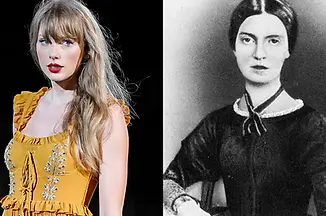
Emily Dickinson and Taylor Swift may be sixth cousins (Hatcher, 2024), but they have a lot more in common than distant family ties. Dickinson wrote about the elusive and terrifying nature of fame. Swift writes about the suppression and isolation she feels while existing in the public eye. Taylor Swift lives a life that her distant cousin Emily Dickinson both coveted and rejected, and Swift has her own complex feelings about the fame in which she operates. While more than 100 years separate the two writers, themes present in each of their pieces suggest the women share similar attitudes and narratives about the fleeting, restrictive, and seductive nature of fame – and what it means for their body of work...

Maggie Burnett
Lone Star College - Montgomery
Beef was chosen as the center for this study since it is a household staple and grocery price increases continue to be a national concern for consumers. Studies published within the last 20 years, fully address the relationship between prices and supply lines; however, there is little research into product and goods price relationships. To understand the correlation of prices on a consumer level, individual products were chosen as follows: economic relations, including inflation and Covid-19; competing industries, such as milk and cheese and related products; supply inputs, such as gas and corn; and lastly, substitute goods, including pork, chicken, and fish and seafood. The price data was found using the Bureau of Labor Statistics...